I Am Still Here

My 90-year-old neighbor supervised me while I dug up the lawn along our fence to plant a shared garden during lockdown. He shook his head and said, “My wife was strong. But you’re about the strongest woman I ever did see.”

Anne Giles

At museums, I have recognized only one other female figure shaped as I am, a Roman statue of a wounded Amazon at the Metropolitan Museum of Art in New York. I have been strength-training since I was 13. That’s 50 years.

These days, who I am seems only to exist in a Zoom screen. Who I was has been pulled like so many weeds from my father‘s memory by dementia. I have been attempting to learn Mandarin Chinese. If I speak aloud and no one answers, am I still here? Am I still me?

When I saw Debbie Smith had captured the true and beautiful selves of my friends in their “40 Over 40” photos, I asked if she would see me, too.

“I am still here.” That’s what these photos say to me. In spite of living in isolation during a pandemic, in spite of my identity as my father’s daughter eroding hand-in-hand with his own identity, in spite of the diminishments of aging, I am still myself.

Like a colored plate in an illustrated specimen book of plants and flowers, I am just one among the 100 billion humans estimated to have ever lived.

On my page in that history – the first and worst tragedy in my life – my hips were never widened, my breasts and belly never softened by childbearing. These photos document what a face and a body with this bittersweet story look like.

What I feel for myself as I look at these photos – and for all 100 billion of us – is deep compassion and appreciation. How exquisite and tragic this being human is! How brave we all are!

Anne Giles

Photos by Debbie Smith

All content on this site is for informational purposes only and is not a substitute for medical or professional advice. Consult a qualified health care professional for personalized medical and professional advice.

What I Wish I Had Been Told About Dementia

In early 2018, my father told me he had tried to  vacuum the dining room rug but the machine wouldn’t turn on. He loaded the vacuum cleaner into the car and drove it to the repair shop. The technician plugged it in, flipped the switch, and the vacuum cleaner started humming. My father shook his head at the fickleness of machinery.
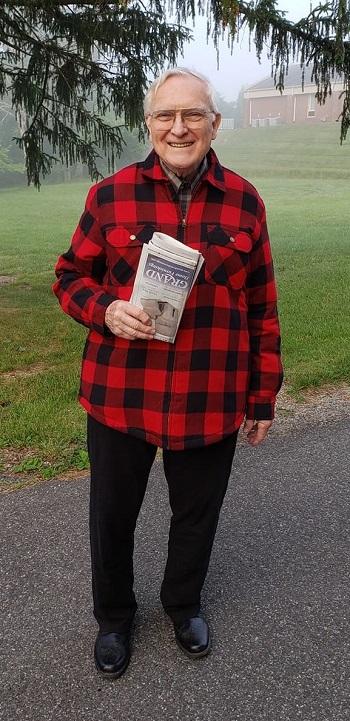
Bob Giles at 86

Several months later, my father told me he had driven his car to the gas station to fill it with gas but couldn’t remember how to use the pump. He asked his assistant for help. She drove with him to the gas station. She showed him again and again how to pump the gas. An action he had performed thousands of times for seventy years, he was unable to duplicate.

This is what I wish I had been told about dementia.

Your father has dementia.

Today, I understand why the “d-word” – “dementia” – is avoided by medical professionals, assisted living providers, and human beings everywhere. It’s not just out of fear. It’s out of terror. I understand that much about the cluster of symptoms known as “dementia” is unknown. Nonetheless, the suffering that resulted from ignorance for my father, me, and our family was cruelly unnecessary.

My father, an Eagle Scout, President of the Corps of Cadets as a senior at Virginia Tech, Professor Emeritus of his alma mater, having the ethics of a philosopher and the manners of a gentleman, was evicted from an assisted living facility after being there only five months because of his behavior.

This experience was appallingly cruel, humiliating, and baffling to my father, to me and my sister. In addition to traumatizing our family, I believe it was traumatizing for the staff members tasked with informing us of this decision as if my father had “gone bad.”

Instead, I imagine us receiving:

  1. a brief handout with the informational text from this post,
  2. the results of a board certified gerontologist’s assessment of my father’s state and prognosis, including an overview, in layperson’s terms, of the criteria by which the results had been determined,
  3. a list of options for alternative care,
  4. a supportive session to answer our questions.

I, my sister, and my father would have been informed. We could have made sad but calm arrangements for another place to live that offered the care he needed. Instead, the psyches of individuals in our family, our family system, and our family finances were detonated.

My father had moved out of his home of 50 years to a two-bedroom apartment. He was banished from it five months later. Under urgent conditions, we were able to find this Professor Emeritus one room in a small private residence.

I understand fear and avoidance. I protest inhumanity.

“A mind that could be so alive one moment with thought and feeling building toward the next step and then someone erases the blackboard. It’s all gone and I can’t even reconstruct what the topic was. It’s just gone. And I sit with the dark, the blank.”
– Sandra Bem, American psychologist, immediately after receiving a diagnosis of Alzheimer’s, quoted in Jakhar et al., 2021

Dementia, resulting from one or more illnesses, is progressive and irreversible. There is no effective treatment or cure.

“Dementia” isn’t a diagnosis. “Dementia” is the term for a set of symptoms resulting from brain-damaging diseases such as Alzheimer’s and others. This damage to the brain results in reductions in memory, ability to recall and form words, ability to use logic and reason, and ability to learn new information. These symptoms are not a normal sign of aging. The causal disease is difficult to determine and usually requires an autopsy to accurately diagnose.

There is nothing that can be done.

Even if the world’s leading physicians provided medical care, a team of round-the-clock expert nurses provided daily living care, the most skilled occupational specialists provided stimulation and engagement, and the person was served gourmet meals with brain-focused nutrition at a spa, the person’s brain would deteriorate.

Dementia is progressive and irreversible. There is no treatment or cure.

Brain deterioration offers sucker punches of hope and despair.

For awhile, brain networks reroute to bypass damage caused by brain illnesses. As the damaged portions accumulate, brain networks can no longer bypass the extensive areas of damage. Intermittently, functionality may return due to unknown re-routings or temporary reconnections. Mental and physical functionality inevitably decline.

Ultimately, nothing works. Nothing.

Accept that “try harder” has no place in the world of dementia.

My greatest regret from caring for my father for the past three years is urging him to try harder. I encouraged him to focus. I broke procedures down into steps, typed them up, and put them under magnets on his refrigerator. I ordered books from Amazon with the subtitles “How to beat dementia.”

The person with dementia cannot try harder. The person can barely access the brain functions from which trying emerge. And trying has no impact upon brain deterioration.

For the person who is caring for the person with dementia, trying harder, trying to do more, trying other ways won’t help. I wish I had known to be merciful to my father and to myself and let go of trying harder.

You are very likely to experience existential distress.

The premise of “trying” is that one has the power to make a difference. Power, freedom, and efficacy are hallmarks of being human. Dementia challenges the very nature of being human, for both the person and the person’s caregivers.

In sum, per Freter, 2016, the person with dementia loses existential understanding on many levels: one’s own biography through loss of memory, loss of one’s ability to perceive or interpret reality meaningfully, imposition of new realities from delusion and hallucination, and loss of previously-derived strategies for making meaning of reality and one’s place in it. Neuro-degenerative losses result in the loss of an ability to make a new life story, to establish one’s existence as a self. The desire to be real in reality is deeply human. What’s termed “agitation” in dementia care may be the volatility that results from the human need to resolve perplexity and see and act on one’s deeply human longing to be real – to be self-determined – in the reality one perceives. Dementia makes this existential human drama perpetual.

The person with dementia is powerless over the deterioration of his/her/their brain. Many are conscious of the decline, suffer grievously, and experience profound existential distress.

Caregivers of people with dementia are powerless to stall or reverse the brain deterioration in their person, nor offer existential relief. As Jakhar et al., 2021 put it, “Dementia ravages what was known and loved about the person.” This results in caregiver distress on many levels. Not only does the caregiver experience sorrow at the decline of the person, but they helplessly witness another human strive fruitlessly and suffer.

My own existential distress has been deep and complex. I studied research on the particular existential distress of dementia caregivers and wrote these materials to help myself:

I am exploring the concept of “existential maturity” as possibly helpful.

Assisted death is not an option.

Assisted deaths are only allowed when the person is considered mentally competent to make the decision on their own. Even in states or nations that permit assisted death, the person’s decision has to be supported by physicians willing to document that support. Once symptoms of dementia have emerged, assisted death is no longer possible.

The unspoken “treatment plan” for people with dementia is ghastly.

Because people with dementia cannot receive physician-assisted suicide, this is the unspoken-of, barely acknowledged “care plan”:

  1. Keep the person as engaged and comfortable for as long as possible until they fall and/or develop another illness.
  2. Now bedridden, in pain, and feeling unwell, hopefully medicated for pain and distress, keep them as comfortable as possible.
  3. See how long their automatic eating and drinking reflexes work until they stop eating and drinking.
  4. Keep the person medicated and clean while they die from starvation and dehydration and/or a co-occurring illness or illnesses.

Plan for deterioration and death, not rehabilitation and restoration.

I am in the middle of this and have limited insight.

My father’s memory and reasoning began to decline in 2018 when he was 85. With great sorrow, he agreed to move into an assisted living facility. In February, 2019, he experienced psychosis, left the facility in the middle of the night, and was evicted.

My father experiences hallucinations and delusions. He continues to protect his daughters from as much hardship as he can, but he has reported he sees threatening men, dismembered animals, children to be protected, and substances to be scraped up painstakingly from the floor. He once gestured with his cupped hand and poured the substance into my hand as if it were glitter.

When he left the facility that evicted him, he stated that he heard people in the next room who were planning to kill him. He headed out in the snow to walk to his male friend and assistant’s house, about two miles away.

Subsequently, I learned that eviction of elderly adults from assisted living facilities is common.

My father stayed with me for several nights until we learned of an opening at a three-bed, private, assisted living residence. His emotional, mental, cognitive, and physical functioning decline incrementally. In Orwellian terms, “Falls are part of the process.” He fell on 09/23/21 and experienced a blow to the chest that caused him great pain. As of this writing, 12/27/21, he has regained physical comfort and stability.

My father has lived at a home that is not his own, with people he does not know, without the ability to read the research in his field or contribute to it, intermittently plagued by perceptions of threat and horror, for two years and nine months. If he lives, that will be three years in February, 2022. If he lives, he will be 89 years old in May, 2022.

Note to the reader: Do you see how I am not answering the question, how I am writing about what happened rather than what I feel or think? This is shock and numbing, understandable and normal under these circumstances. I am kind to myself and accept that, until my father no longer suffers, I will suffer to some extent.

Grieve now.

Paradoxically, this is, of course, difficult to do during shock and stress. So, why? Isn’t it better to control emotions and keep it together?

Although it’s more complicated than this, the human brain has actually evolved to handle both the joys and sorrows of the human condition. Put more simply, humans have evolved to naturally feel natural emotions. Resisting and avoiding feelings taxes the brain’s functions and resources more than experiencing them does.

The problem is that some thoughts exacerbate feelings. Thinking “Things shouldn’t be this way” escalates feelings to beyond-capacity levels.

I wish I had been told this: “Try not to tell yourself you should feel differently, should be doing better, or should be doing more. Cry and cry about the truth of what is, what can’t be done and changed, and how hard it all is.”

O, the synonyms for “grief”! What am I feeling?! Sadness, sorrow, bereavement?! How do I help myself with this?! I did research and wrote about grief, too.

Experiencing grief while caring for a person with dementia is complicated by anticipatory grief – grieving now at the slow death of the person’s selfhood, all the while knowing you will grieve again at the loss of the life – disenfranchised grief from private losses others may not understand, and ambiguous grief – both wanting the person to die and free themselves and you – and wanting to hold onto them forever.

It’s complex.

Advocate for research-informed relief from suffering.

Many beliefs exist about how to care for people with dementia. Humans naturally practice folk medicine. Meaning still matters. Use PubMed to research conditions troubling your person, derive practical solutions, and ask for their implementation.

Know that caring for people with dementia requires skills that love for them doesn’t provide or teach.

How to engage with, lead, lift, and bathe people with dementia so they don’t suffer from unintentional consequences of unskilled care, e.g. sores and urinary tract infections, requires skilled care. Love does not equip people to provide skilled health care.

Long ago, my father asked and answered his own set of existential questions. He took both me and my sister to the attorney’s office and gave us complete, joint control of his affairs. He insisted that, if he became unwell, neither I nor my sister would bring him to live with us. He wanted us to be free to live our lives.

I see now that I would likely cause greater suffering to my father if I were to equip my guest room for him. He needs 24-7 assistance. I would do my best to schedule around-the-clock care for him. If the skilled caregiver were ill? My unskilled, untrained love would be on duty.

Speak your love now.

Although intermittent functionality may occur, speak of your love now and perform your loving acts now during this time while some mutual connection exists. The connection waxes and wanes.  Eventually, the caregiver may receive little but the knowledge that they are keeping this struggling, suffering person from having to endure this troubling illness alone.

Watch for, alleviate, and get help with trauma symptoms.

I predict that few caregivers of people with dementia can avoid developing symptoms of exposure to trauma. Hearing, seeing, witnessing, and experiencing distress over and over again, over time, is deeply wearing on people. Here’s a self-help guide for reducing trauma symptoms.

Be cautious about asking for help.

I prefer to think most people mean well. However, when I have expressed distress or had difficulty with a problem, I have generally been told that I am not feeling or thinking correctly, or am perceiving things incorrectly. In clinical terms, this is termed invalidation.

Serving as a caregiver for a person with dementia is almost unbearable. The added burden of “help” from others has almost broken me. I have learned to consult a small group of safe people who are not afraid of my – or their own – feelings, thoughts, and experiences.

My greatest source of comfort has been the published research on dementia and on serving as a dementia caregiver. Accompanied by facts and reality as best as the finest minds using rigorous scientific methods can discern, my plans are reality-based and, therefore, are more likely to be effective than myth-based or belief-based speculations.

Be your own care provider.

No matter how large or small a caregiver’s group of supporters is, most of the time, caregivers serve solo as their own 24-7 support staff members, consultants, mentors, and solace.

Practice a particular kind of self-care. From self-care protocols, make and execute a plan to engage in self-care practices that foster the qualities needed by dementia caregivers: forbearance, endurance, and resilience.

See, and pause to acknowledge, small beauties.

I have dismissed advice like this in the past as invalidating, toxic positivity.

However, dementia robs life of so much that small moments of beauty feel like satiation of hunger. I savor them like wedges of baklava dripping honey down my arm.

How I miss sharing such things with my father! How I miss my father!

I offer a paraphrase of Irvin Yalom, M.D., who, at 88, after losing his wife of 65 years and finding himself living alone during a pandemic wrote: “Even if the small things that happen are known only to me and can’t be shared with others, they are still beautiful and still matter.”

Knowledge is power.

A friend confided in me that dementia was feared to have developed in a loved one. I expressed regret and sorrow and mentioned one or two items on the above list. The person grabbed my arm and said, “You’re not cheering me up!”

I have pondered this observation and she is completely right. I don’t have cheer to offer. But I do have power to offer.

Before the first episode of psychosis hit, my father said, “If you think anything about my story might be helpful to others, please share it. You have my permission to share it.”

Silence about dementia keeps its realities unknown and capable of enormous damage. If I had known three years ago what I know now – readily available information! – I could have more skillfully stewarded my father, myself, and our family through this time of beyond-words hardship.

With his permission, I share his and our story in case it may prevent others from the needless suffering brought about by simply not knowing better.

. . . . .

Other than Alzheimers New Zealand, Alzheimer’s Society – United Kingdom, and Alzheimer Society of Canada, I have no other general sites, books, or resources to suggest. I have been referred to other sites of organizations and pundits. I found pat answers. I have not found the pundits’ names among the published research literature, nor citation of sources among their posts. Folk wisdom, practice wisdom, quackery, and generalizations from case studies dominate contemporary commentary on dementia.

I found this 6-hour continuing education course for counselors, Alzheimer’s Disease & Other Dementias Certificate Program, extremely informative.

I found these books on dying troubling, but they helped give me power. The list is in alphabetical order by the author’s last name.

Added 2/8/22

I found the “Care for the caregiver” section in this guide from Harvard Medical School of value. It was published in 2018. A copy was given to me by a colleague in February, 2022.

This guide may be the one that care facilities need to give to the families of their residents:

Update on 4/20/22

Based on my father’s experience of anguish, I have written my own Advance Directive for Dementia Care.

The views are my own. This content is for informational purposes only and is not a substitute for medical or professional advice. Consult a qualified health care professional for personalized medical and professional advice.

An Invalidating Environment

Emotion dysregulation is posited as a central component of many human troubles, including those that evolve into mental disorders. The primary, evidence-based therapy protocol for helping people learn skills to regulate emotions is dialectical behavior therapy (DBT), invented by Marsha Linehan, Ph.D.

An invalidating environment

Having experienced “an invalidating environment” as a child is considered a precursor to having difficulty regulating emotions as an adult.

Why care about “an invalidating environment?”

Consciously or unconsciously, directly or indirectly, partnerships, families, schools, companies, workplaces, communities – even entire nations – can create invalidating environments.

In essence, an invalidating environment is one in which people are told what they feel, think, and perceive about themselves, others, and what’s going on isn’t right, true, reasonable, or adequate, especially if they are feeling distressed or having trouble solving a problem.

The subtext is: “You shouldn’t feel the way you feel, you shouldn’t think the way you think, and you shouldn’t see things the way you do.”

Definitions and examples of “an invalidating environment” follow.

Excerpted from Cognitive-Behavioral Treatment of Borderline Personality Disorder by Marsha Linehan, Ph.D., 1993:

“An invalidating environment is one in which communication of private experiences is met by erratic, inappropriate, and extreme responses. In other words, the expression of private experiences is not validated; instead, it is often punished and/or trivialized. The experience of painful emotions, as well as the factors that to the emotional person seem causally related to the emotional distress, are disregarded. The individual’s interpretations of her own behavior, including the experience of the intents and motivations associated with the behavior, are dismissed.”

“Invalidation has two primary characteristics. First, it tells the individual that she is wrong in both her description and her analyses of her own experiences, particularly in her views of what is causing her own emotions, beliefs, and actions. Second, it attributes her experiences to socially unacceptable characteristics of personality traits. The environment may insist that the individual feels what she says she does not (‘You are angry, but you just won’t admit it”), likes or prefers what she says she does not (the proverbial ‘When she says no, she means yes;), or has done what she said she did not. Negative emotional expressions may be attributed to traits such as overreactivity, oversensitivity, paranoia, a distorted view of events, or failure to adopt a positive attitude. Behaviors that have unintended negative consequences for others may be attributed to hostile or manipulative motives. Failure, or any deviation from socially defined success, is labeled as resulting from lack of motivation, lack of discipline, not trying hard enough, or the like. Positive emotional expressions, beliefs, and action plans may be similarly invalidated by being attributed to lack of discrimination, naivete, overidealization, or immaturity. In any case, the individual’s private experiences and emotional expressions are not viewed as valid responses to events.”

The American Heritage Dictionary defines invalidate as “to make invalid; nullify.” Here are links to definitions of valid and invalid.

In a 2018 systematic review, Musser et al. identified specific traits of an invalidating environment.

“Across measures, the most highly represented aspect of the invalidating environment was misattribution of the child’s emotional experience or expressions to negative characteristics of the child. Misattribution was embodied in items such as blaming one’s child for their being sexually abused, or asserting that their feelings or behavior is the result of negative attitudes or ulterior motives.”

“Discouraging of negative emotions was the second most represented aspect of the invalidating environment. Items which measured this aspect included instructing one’s child to stop crying, or warning them that discussion of their negative emotions will make them feel worse.”

“Parental communication of the child’s emotional inaccuracy to the child was the third most represented aspect. An example of an item which measured this aspect is a parent responding to their child’s expression of pride by telling them not to be so confident. Communications of inaccuracy as well as misattribution could be found in reference to the child’s expression of both negative and positive emotions.”

“Oversimplification of problem solving or minimizing of difficulties was the least represented aspect of the invalidating environment. Items such as telling the child that their problem is easily solvable or that they are overreacting were found to align with this construct.”

Here are some subtle examples of invalidating and validating statements in each of the above categories.

1. Misattribution of the child’s emotional experience or expressions to negative characteristics of the child.

Invalidating: “Why are you upset? You’re being too emotional.”

Validating: “You seem upset. What’s up?”

2. Discouraging of negative emotions.

Invalidating: “Why are you so upset? There’s nothing to cry about.”

Validating: “It makes sense that you would feel upset about this. Shall we talk about it now or a little later?”

3. Parental communication of the child’s emotional inaccuracy to the child.

Invalidating: “Feel proud of your hard work?! You’re just lucky!”

Validating: “You worked so hard for this. I appreciate and respect your courage, effort, and tenacity.”

(The above example is a paraphrase of an exchange actor Will Smith describes in his memoir Will about his father’s response to his artistic and financial successes.)

4. Oversimplification of problem solving or minimizing of difficulties.

Invalidating: “If you just did it right, you wouldn’t have these problems.”

Validating: “I see how much you care and how hard you are trying. Let’s see if we can work out other ways to do this.”

5. Shift of topic to the self or domination of the “air time.”

Invalidating: “That’s too bad. What I did in that situation was _____.”

Validating: “Tell me more.”

How does emotion dysregulation result from an invalidating environment?

Children look to their caregivers to help them make sense of their feelings, thoughts, words, and actions. If caregivers consciously or unconsciously, directly or indirectly, communicate that what children are feeling, thinking, and perceiving isn’t correct, disorientation results. Children learn they can’t trust the reality of their own inner experiences or the accuracy of their perceptions of what’s happening. Paired with other traumas and attachment wounds, children are denied learning the skill of “mentalisation,” defined by Campbell and Lakeman in 2021 as the ability to “accurately reflect on and think about the thoughts, feelings, motivations and behaviour of oneself or others.” Missing this sense of order, the inner sensation is an alarming, terrifying sense of spinning in chaos. Distress is constant, although many learn to mask or suppress distress, or distract themselves from it.

As adults, freed from caregivers, people with emotion regulation challenges can seek what offers a sense of safety and control. Some methods work well in society – excellence in academics, sports, arts, or work – and some are problematic: use and overuse of substances, over- or undereating, bingeing and purging, shopping, gambling, and having multiple sexual partners, for example.

(Verywell Mind also offers a helpful exploration of “an invalidating environment.)

How does dialectical behavior therapy (DBT) help people regulate their emotions?

At essence, DBT pairs what we know about enjoying and enduring the human condition with brain science. As an I-statement, it looks like this:

“If I can ask myself what I’m feeling and thinking, that simple act eases the emotion centers in my brain and activates the cognitive centers. Using my own cognitive functioning, I can look at the facts and use logic and reason to decide what would be most helpful for me to say or do next – or not say or not do.”

Here’s the inner dialogue a person might use while regulating emotions.

This bears repeating:

Consciously or unconsciously, directly or indirectly, partnerships, families, schools, companies, workplaces, communities – even entire nations – can create invalidating environments.

Examples:

  • “Don’t be so sensitive.”
  • “You’re overreacting.”
  • “You misunderstood me.”
  • “Look on the bright side.” (From Medical News Today: “Toxic positivity imposes positive thinking as the only solution to problems, demanding that a person avoid negative thinking or expressing negative emotions.”)
  • “You’re getting yourself worked up about nothing.”
  • “That’s not the way we do things here.”
  • “You’re just not working hard enough/doing it right/________.”
  • “If you hadn’t _________, if wouldn’t have happened. You were asking for it.” (False attribution of causality is a form of gaslighting and results in victim blaming.)
  • ”You’re misperceiving the situation.”
  • “You need to change your thinking.”
  • “You’re just in a slump/phase.”
  • “If I were you, I would __________.” (Here’s an excellent post from Tiny Buddha on what a person really hears when given unsolicited advice.)
  • “See? You didn’t need to get so upset about that.”
  • Silence. Giving people the silent treatment – termed “stonewalling” by the Gottmans – or cutting off all contact  – often termed “ghosting” – communicates that the person isn’t valid or important enough to even merit contact.

The inner narrative of a person who makes an invalidating statement may be:

“I feel uncomfortable with what you are feeling, thinking, saying, and/or doing, or with what happened to you, so I’m going to try to make you change or make you responsible so I can feel better.”

What can adults do to possibly begin to transform an invalidating environment into a validating one?

1. Take courageous responsibility for what they are feeling and thinking.

Denying, resisting, avoiding, suppressing, and misidentifying feelings can be a cultural norm. Protest this! The human brain has evolved to feel emotions. Feelings provide crucial data about what’s going on and can offer guidance about helpful, useful, effective next steps.

2. See reality as it is, neither less nor more, neither positive nor negative.

Although we might wish it were otherwise, feel terrible about what’s happening, and long to spin it differently, acknowledge reality as it is and attempt to see and discern its complexity.

3. Use I-statements rather than you-statements.

People who share who they are and what they see – rather than tell others who they should be and how they should think and do things – powerfully communicate that other people matter and are worth talking with about what’s really important.

Say what needs to be said. There is a good formula from the field of “nonviolent communication”: When X happens (stated objectively; not “when you are a jerk”), I feel (emotions; not “I feel you are an idiot”), because I need Z (deep needs like “to be safe, respected, emotionally close to others, autonomous and not bossed around”).
– Rick Hanson, Ph.D., Stay Right When You’re Wronged

4. Co-create solutions.

When people share their genuine, inner experiences, that’s usually paired with expressions of inner wisdom. This occurrence is the essence of relational effectiveness. Genuinely spoken words in a validating environment can catalyze synergistic problem-solving of surprising effectiveness and beauty.

. . . . .

Of possible additional interest:

Last updated 2/7/23

Image: iStock

This content is for informational purposes only and is not a substitute for medical or professional advice. Consult a qualified health care professional for personalized medical and professional advice.

A Self-Assessment and Tool for People Who Serve as Caregivers for People with Dementia

Being a person who gives or coordinates care for a person with the set of symptoms termed “dementia” is a rare occurrence.

Currently, approximately 88% of the U.S. population aged 65 and older and 93-95% of the world’s population aged 60 and older have not developed symptoms of dementia. While the number of people with dementia is expected to increase through 2050, percentages are not.

Being a person who cares for a person with dementia is also a nearly singular experience, having some common and also unparalleled elements with other caregiver roles.

Rather than a diagnosis, “dementia” is the term for a set of symptoms resulting from brain-damaging diseases such as Alzheimer’s and others. This damage to the brain results in reduction of memory, ability to recall and form words, ability to use logic and reason, ability to learn new information, and other reductions in abilities.

As brain-damaging diseases begin to cause the set of symptoms termed “dementia,” brain networks reroute to bypass the damage. As the damaged portions accumulate, brain networks can no longer bypass the extensive areas of damage. Mental and physical functionality declines. Intermittently, functionality may return due to unknown re-routings or temporary reconnections. The causal disease is difficult to determine and usually requires an autopsy to accurately diagnose.

Dementia, resulting from one or more illnesses, is progressive and irreversible. There is no effective treatment or cure.

In caring for a terminally ill person without cognitive impairments, a caregiver witnesses the declining health of the person for whom they are caring. A caregiver for a person with a degenerative cognitive impairment, such as dementia, witnesses erasure of personhood, as well as declining health.

The human brain has evolved to work effectively with the reality of its environment. Most people, most of the time, behave within a predictable range. When the very essence of what makes a person human deteriorates before a caregiver’s eyes, and the person continues to live but speaks and acts in ways that seem inhuman, the experience for the caregiver can seem other-worldly, even horrific.

As a result of challenges to their reality created by this illness, caregivers can experience a devastating loss of connection with the self and the self’s inner resources: losses in self-awareness, self-empathy, self-compassion, self-efficacy, invention and creativity, and inner wisdom.

On an on-going basis, witnessing the person’s suffering, their abnormal words and actions, paired with experiencing the loss of connection with self, and connection with the person even though they sit or stand in front of them, can seem surreal, disorienting, harrowing, traumatic, and painful to the point of being torturous, calling into question the caregiver’s own reality, even the very meaning and purpose of existence. The caregiver’s suffering can be acute.

I have created “A Self-Assessment and Tool for People Who Serve as Caregivers for People with Dementia.” The 8-page .pdf elaborates upon the content of this post and includes the self-assessment and tool. The document contains approximately 2,500 words.

The self-assessment and tool attempt to synthesize research findings on the experience of people who serve as caregivers for people with dementia, research on effective treatment for trauma, and research-backed elements of therapies derived from cognitive theory and other therapies, to ease the particular suffering of the person who serves as a caregiver for a person with dementia.

Of possible additional assistance

With questions or comments, please contact me.

A Self-Assessment and Tool for People Who Serve as Caregivers for People with Dementia

Personal essay: What I Wish I Had Been Told About Dementia, 12/27/21

. . . . .

Selection of sources consulted (listed with inconsistent citation format):

Albinsson L, Strang P. Existential concerns of families of late-stage dementia patients: questions of freedom, choices, isolation, death, and meaning. J Palliat Med. 2003 Apr;6(2):225-35. doi: 10.1089/109662103764978470. PMID: 12854939.

Applebaum AJ, Kryza-Lacombe M, Buthorn J, DeRosa A, Corner G, Diamond EL. Existential distress among caregivers of patients with brain tumors: a review of the literature. Neurooncol Pract. 2016 Dec;3(4):232-244. doi: 10.1093/nop/npv060. Epub 2015 Dec 8. PMID: 31385976; PMCID: PMC6657396.

Day J, Higgins I. Existential Absence: The Lived Experience of Family Members During Their Older Loved One’s Delirium. Qual Health Res. 2015 Dec;25(12):1700-18. doi: 10.1177/1049732314568321. Epub 2015 Jan 20. PMID: 25605755.

Freter, Björn. On the Existential Situation of a Person with Dementia: The Drama of Mankind is repeated in the Drama of Dementia
October 2015 Journal of Health Science 3(5):205-216
DOI:10.17265/2328-7136/2015.05.002

Galfin JM, Watkins ER, Harlow T. A brief guided self-help intervention for psychological distress in palliative care patients: a randomised controlled trial. Palliat Med. 2012 Apr;26(3):197-205. doi: 10.1177/0269216311414757. Epub 2011 Aug 1. PMID: 21807750.

Kühnel MB, Marchioro L, Deffner V, Bausewein C, Seidl H, Siebert S, Fegg M. How short is too short? A randomised controlled trial evaluating short-term existential behavioural therapy for informal caregivers of palliative patients. Palliat Med. 2020 Jun;34(6):806-816. doi: 10.1177/0269216320911595. Epub 2020 Apr 29. PMID: 32348699; PMCID: PMC7243077.

Schulz R, McGinnis KA, Zhang S, Martire LM, Hebert RS, Beach SR, Zdaniuk B, Czaja SJ, Belle SH. Dementia patient suffering and caregiver depression. Alzheimer Dis Assoc Disord. 2008 Apr-Jun;22(2):170-6. doi: 10.1097/WAD.0b013e31816653cc. PMID: 18525290; PMCID: PMC2782456.

Selman LE, Brighton LJ, Sinclair S, Karvinen I, Egan R, Speck P, Powell RA, Deskur-Smielecka E, Glajchen M, Adler S, Puchalski C, Hunter J, Gikaara N, Hope J; InSpirit Collaborative. Patients’ and caregivers’ needs, experiences, preferences and research priorities in spiritual care: A focus group study across nine countries. Palliat Med. 2018 Jan;32(1):216-230. doi: 10.1177/0269216317734954. Epub 2017 Oct 12. PMID: 29020846; PMCID: PMC5758929.

Sellars M, Chung O, Nolte L, Tong A, Pond D, Fetherstonhaugh D, McInerney F, Sinclair C, Detering KM. Perspectives of people with dementia and carers on advance care planning and end-of-life care: A systematic review and thematic synthesis of qualitative studies. Palliat Med. 2019 Mar;33(3):274-290. doi: 10.1177/0269216318809571. Epub 2018 Nov 8. PMID: 30404576; PMCID: PMC6376607.

Last updated 1/13/22 with link to Estimation of the global prevalence of dementia in 2019 and forecasted prevalence in 2050: an analysis for the Global Burden of Disease Study 2019, 1/6/22 https://doi.org/10.1016/S2468-2667(21)00249-8

Wander van der Vaart and Rosanna van Oudenaarden. The practice of dealing with existential questions in long-term elderly care. International Journal of Qualitative Studies in Health and Well-Being, 2018.

This content is for informational purposes only and is not a substitute for medical or professional advice. Consult a qualified health care professional for personalized medical and professional advice.

Contributing to the Collective Story of the 100 Billion

Inadvertently, simply from being a member of the species Homo sapiens, I will contribute to the story of the 100 billion humans estimated to have ever lived on the planet Earth. My life’s story, only 1/100 billionth of the whole, however small, will be part of this corpus. Although my part is very small, I feel a great responsibility to contribute usefully and humanely. When my time is up, what do I hope to be able to say is true? To our collective story, in the time I have on this planet, what might I contribute?

100 billion people in human history


The question, “What might I contribute?”, synthesizes elements from the ultimate existential concerns identified by many thinkers about the nature of being human. My existential thinking has been influenced most recently by Irvin Yalom, M.D. and Marilyn Yalom, Ph.D. Stated simply as continua, these themes are: life vs. death, freedom vs. dependence, connection vs. isolation, and meaning vs. meaninglessness.

Asking, “What might I contribute?” requires courage. It requires the fortitude to consciously become aware of several troubling realities.

First, the question requires approaching the reality that a human life is finite; it has a beginning and an end. We will have the time we have and no more.

Second, it requires approaching the reality that we may be able to influence what happens, but rarely can we insist on outcomes. Even the collective brains of the current 8 billion people on the planet – each with an estimated 100 billion neurons and an equal number of glial cells – cannot comprehend the complexity of reality. Using logic, reason, and data, we can calculate probabilities, not name certainties.

Some might protest, “There are eight billion people now?! And one hundred billion people ever?! My life is too small! How could I possibly contribute or make a difference?!”

When I lived in Tampa, Florida, while also a middle school teacher at a college preparatory school, I was a part-time reporter for what was then The St. Petersburg Times. I was assigned a story about a young girl who wrote and hand-illustrated books for her little sister.

Awed and enchanted by the young girl, I referred her to our school. Intellectually and artistically extraordinary, she was accepted, and became one of my own English students. One of her electives was theater arts and I attended a play in which she was performing.

On the stage, the young girl had been transformed into an elderly woman, her dark hair pomaded white. She wore a Sunday-best dress, a white cardigan over her shoulders, and sturdy, low heels. As she rocked in a rocking chair, she spoke wisdom from her long life.

I wept. I wept with gratitude for the playwright, for the drama teacher who selected the play to perform, for my student for playing this part, for her bravery and forbearance as a person and as a character, and for myself, an unwittingly childless woman who would have no legacy of her own, witnessing the possible future of humanity in such noble hands.

A synthesis of the guidance offered by philosophers, theorists, and researchers in science, psychology, and education suggest asking the following questions may offer a systematic framework for answering, “In the time I have, how might I contribute?“

  1. What are my strengths?
  2. What are my interests?
  3. What are my values?
  4. What are my priorities?
  5. Based on my strengths, interests, values, and priorities, what possibilities exist for my contributions?
  6. Which of these possibilities are based in humanity, logic, reason, and fact? Let me remove possibilities that are zealous or unverifiable.
  7. Of the remaining possibilities on the list, how would I rank order them based on probabilities? In other words, although I might wish otherwise, through which of these am I most likely to be able to contribute?
  8. Among these probabilities, which shall I choose as my primary ends in mind? Let me define them precisely.
  9. What are the constraints upon my intentions? One constraint during this pandemic is unpredictability. How can I optimize within these constraints?
  10. How will I know when I have reached my ends in mind? By what criteria will I evaluate progress towards these ends?
  11. Now that I have asked these questions and defined these terms carefully, what plans shall I make and what strategies will I use?
  12. How will I accommodate and monitor a primary constraint on human endeavors, i.e. my need for self-care? and to attend to my needs, wants, and aspirations?
  13. How will I accommodate these opposites both being true: “I want to give my all to taking care of myself and the beings close to me” AND “I want to give my all to contributing to the greater good”?

Above all, am I as kind to myself as possible? Regardless of what happens in my story – or in the story of the 100 billion – regardless of how short or long my time on the planet may be, am I helping myself – in my “one wild and precious life” – have the most kind, humane, and generously-spirited story I can?

This post is dedicated to Robert H. Giles, Jr., my father, whose ethics and existential questioning ground this essay. He contributed.

. . . . .

This post on existential questions is part of a series in the Guide category for people who, in these times of limited contact and resources, are attempting to find ways to help themselves. The post links to related, possibly useful exercises for further thought and exploration.

These guides may be of particular interest:

Views expressed are the author’s own. This content is for informational purposes only and is not a substitute for medical or professional advice. Consult a qualified health care professional for personalized medical and professional advice.