A Paper-and-Pen Alternative to Using SRS with Mandarin Blueprint

Mandarin Blueprint‘s founders, Luke Neale and Phil Crimmins, have invented a systematic, comprehensive, research-informed method for learning Mandarin Chinese. In an innovative application of the method of loci – a memory strategy attributed to the ancient Greeks and Romans – Mandarin Blueprint users are taught to learn Chinese characters by envisioning places from their own histories, then imagining actors interacting with props in rooms within those locations. Through this creative process, the Chinese character’s pronunciation, meaning, reading and writing are all conveyed. The founders term their invention the “Hanzi Movie Method” and report it has cleared the second stage of the U.S. patenting process.
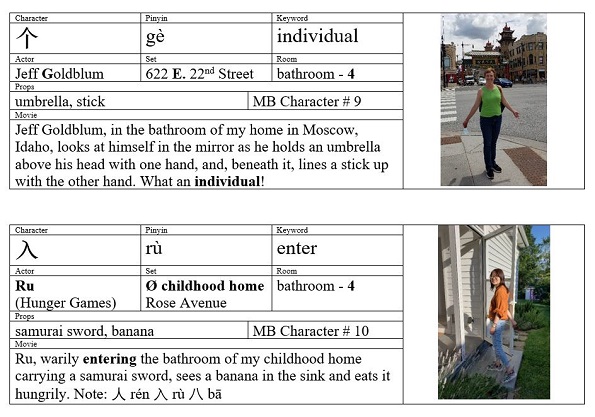
Sample printable flashcards for Mandarin Blueprint

Reviewing Chinese characters with Mandarin Blueprint’s method is augmented with spaced repetition software (SRS) to replace printed flashcards. Mandarin Blueprint’s current choice of SRS is Anki. Mandarin Blueprint is developing its own proprietary SRS and is expecting to beta test it in July, 2021.

I used Anki effectively until I was unable to adjust the settings to limit the number of cards per review session. When I ended up with 800+ cards to review per day, a multi-hour task, I stopped reviewing cards.

Hopeful, however, that I might some day figure out Anki, I continued to use Mandarin Blueprint’s Hanzi Movie Method to create Anki cards for each character. I just never saw the cards again. (I also tried creating a list of flashcards in Skritter but, without prompts to help me remember my custom movie scenes, I found the task tedious, began to dread doing it, then quit.)

Simply through using the Mandarin Blueprint method – with no review at all – I learned to recognize about 100 characters before the forgetting curve overtook me. The lack of review cost me the ability to remember the characters well enough to read simple demo sentences.

I am a true fan of Mandarin Blueprint. I have written about the positive trajectory of my progress after beginning to use its method. I bought the full bundle of Mandarin Blueprint courses through Level 57 and happily contributed at the access level to the crowdfunding campaign to develop the Advanced Course.

I began to ponder. Making the cards in Anki worked pretty well for learning about 100 characters. I just needed to see those cards again to make the characters stick. I needed a low-tech, paper-and-pen alternative to Anki.

I used Microsoft Word to make a Hanzi Move Method data collection form to use as a printable flashcard.

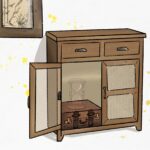
Here is a .pdf of a blank data collection form (opens in a new tab), plus my imagining of a “Tone House” that helps me logically remember which tone goes with which room using the method of loci (also termed “memory palace“). The .pdf includes a list of the first four characters which are simple enough not to require individual cards. (The image accompanying this article depicts the “method of loci” well.)

Here is a .pdf of sample flashcards (opens in a new tab). They include my versions of settings, actors, props, and scenes using the Hanzi Movie Method for characters #5 – #12. As you can see, the fields are not fixed so I can write as little or as much as I want. If I can already sight read a character, I don’t make a card. The goal, of course, is to not make cards, but to learn characters in order to read!

Although Mandarin Blueprint suggests including images for compound words, I’ve included an image field for single characters if needed. For example, I’ve had trouble remembering how to write the top portions of 人 rén, 入 rù, and 八 bā and added images to these cards to try to help myself.

For this post, I created custom images for my sample flash cards to publish online since I don’t hold rights to other images. But I follow Mandarin Blueprint’s method and search the Internet to copy and paste images that speak to me. For example, an image of Snape will always accompany 总是 zǒng shì.

Each character’s flashcard takes 3-5 minutes to imagine then type. The layout is horizontal and I enter one to two cards per page. I print the pages and fold long cards in half horizontally, or use scissors to trim two cards per page into horizontal strips about the same height.

I can review the cards sitting at a desk or lying on the coach. I can spread them on a bed to compare differences in similar characters. I can position the cards to reveal only characters on the left and only English on the right. Flashcards for Levels 1-6 ended up as 24 pages to print.
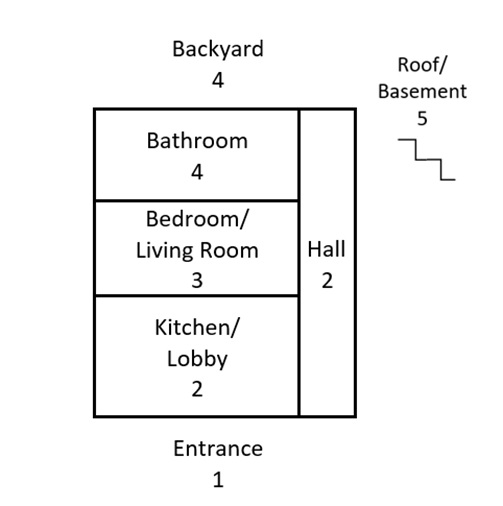
Tone House for use with Mandarin Blueprint

I am my own spaced repetition algorithm! I sort cards into piles based on how well I know the characters. I review cards in the weak piles first, move them to the strong piles, and so on.

Would using spaced repetition software to review characters be optimal? I’m sure it would. I just couldn’t make current SRS offerings work. I’ve signed up to beta test MB’s forthcoming proprietary flash card software. In the meantime, I’m cranking through characters, heading towards a 1,530-character milestone.

For an introduction to Mandarin Blueprint’s Hanzi Movie Method, I recommend the video on MB’s home page  and this YouTube video from the course. Here’s the first entry in a set of articles describing the method.

Why do I encourage people to 1) learn Mandarin Chinese, and 2) try Mandarin Blueprint? I think the state of things in the U.S., plus the state of U.S.-Chinese relations, makes being able to speak each other’s languages an imperative. Time is of the essence. In my earnest quest to learn Mandarin Chinese in my 60s, I’ve spent countless hours researching second language acquisition and thousands of dollars on textbooks, courses, and apps. In my estimation, the most efficient system likely to produce desired outcomes in the shortest amount of time in the most pleasant way is Mandarin Blueprint.

I would love to be part of a local Mandarin Blueprint users’ group that meets in-person in the Blacksburg, Virginia, U.S.A. area. If that interests you or I can be of service in any way, please don’t hesitate to contact me. Added 9/10/21: Several MB users have joined me in the Mandarin Chinese Conversation Groups on Meetup.

I thank paleogeologist and Virginia Tech visiting scholar Tian Gan for helping me create flashcard images.

Views expressed are the author’s own and may not represent Mandarin Blueprint’s positions, strategies or opinions.

Anne Giles, M.A., M.S., L.P.C., is a student of Mandarin Chinese and also a mental health counselor, able to provide counseling services only to residents of the Commonwealth of Virginia, U.S.A. This content is for informational purposes only and is not a substitute for medical or professional advice. Consult a qualified health care professional for personalized medical and professional advice.
Why Am I Studying Mandarin Chinese?

When people ask me why I study Mandarin Chinese, I usually give cognitive, utilitarian answers.

But I also get a feeling from studying Mandarin Chinese.

Conceptually, I give myself 100 years on the planet to use my brain’s approximately 100 billion neurons and perhaps a similar number of glial cells. In lockdown in 2020, at age 61, I decided, after a forty-year hiatus, to return to the study of Mandarin Chinese to save my sanity and put more neurons to use. I have the contented feeling that direction and purpose can bring.

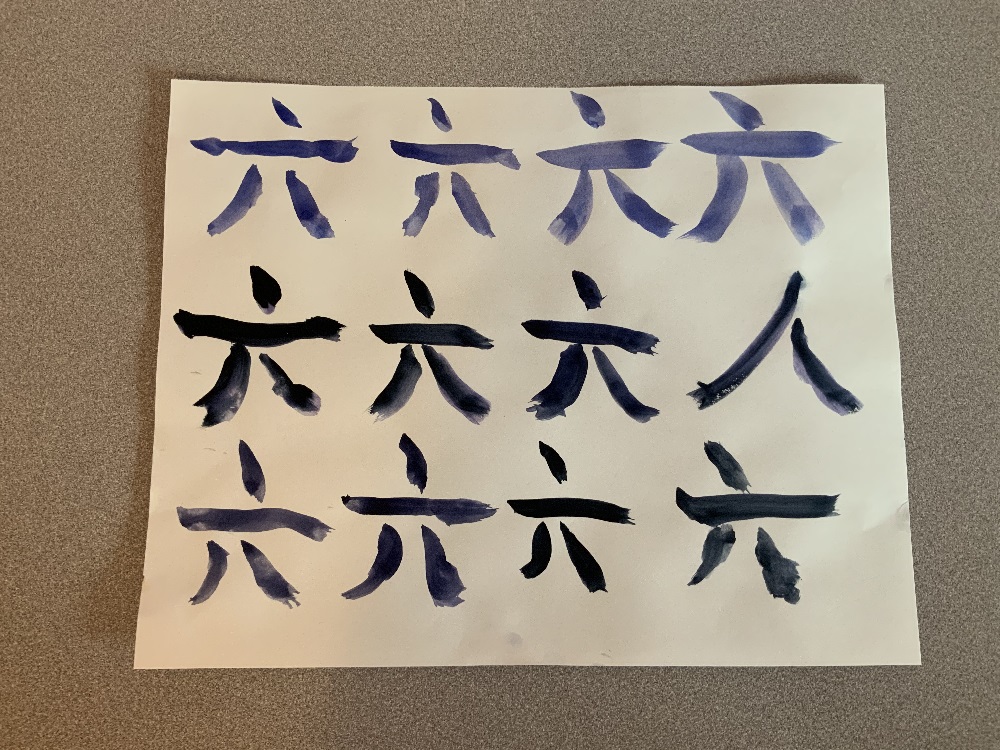
First attempt to write Chinese characters

I also have the feeling I have gotten since childhood from organizing words and pictures on pieces of paper.  If given a choice between playing Barbie dolls or paper dolls with my sister, I would choose paper dolls. When my father was a boy, he collected stamps and, in adulthood, my mother added to his collection. I was allowed to have my own collection and spent countless hours giving names to the animals in the pictures and pouring over images of exotic buildings and dress styles.

When I study Chinese characters, I have this same sense of the shapes on paper being absorbing and wondrous. If I ever get to go to China, my first stop will be Beijing, not to see the Temple of Heaven, but to head to a museum to see the first pictures-as-words carved into  bones and tortoise shells: oracle bone script jiǎgǔwén 甲骨文.

I have a hypothesis about bilingual partnership in older, single adults – for me and my anticipated partner, English and Mandarin Chinese – that I have written about elsewhere that fills my heart with longing and excitement.

I have another feeling as well. It is central and moving, bringing tears to my eyes.

In the 300,000 year history of Homo sapiens, among the 100 billion people who have ever lived, among the nearly 8 billion people currently on the planet, among the 100,000 years that people could speak and the 5,000 years people could write, among the four writing systems identified as developing independently, only one is still in use. Written Chinese is documented as 3,000+ years old.

When I attempt to speak Chinese or to read a Chinese character, I feel connected to the swell of hearts and minds of the whole100 billion. I see their mouths opening and their hands holding slim tools. When they could utter words, what did the first humans choose to say? What did they choose to write? I, too, reflect deeply about what to say and write.

. . . . .

I write about my experience learning Mandarin Chinese in this category.

Please contact me if you have ideas, suggestions or feedback.

I am a beginning student of Mandarin Chinese and also a counselor, able to provide services only to residents of Virginia, U.S.A. This content is for informational purposes only and is not a substitute for medical or professional advice. Consult a qualified health care professional for personalized medical and professional advice.

Do You Provide Research-Informed Care?

This is the central question I urge people to ask counselors, program directors, and other potential providers of treatment for substance use concerns:

“Do you provide research-informed care?”

The common belief is that people who overuse substances need to “go to rehab.” Estimated rates of return to substance use after attending in-patient treatment are 70% or higher in the first three to six months. Recent discussion about the effectiveness of vaccines helps give this number perspective. Rehab has a 30% effectiveness rate. Out of 10 people who attend, only 3 become “protected.” With this poor showing, would we even consider this procedure “effective,” much less offer it nationwide as a “treatment”?

So why don’t rehabs “work”? Why do few “treatments” for substance use concerns reduce or eliminate use?

Because people use substances for reasons.

If the needs and wants met by substance use aren’t identified and ameliorated, if individually meaningful alternatives aren’t found, the reasons still exist and substances will continue to work to address them.

Brain automaticity and other features of substance overuse revealed by neuroscience – usually termed “addiction” – add an additional layer of complexity. Many of these mechanisms can be assisted with medications.

Even if, hypothetically, all the brain mechanisms involved in addiction could be stabilized or reversed, the reasons the person used substances still exist. Particularly if substance use provides relief from physical, mental, or emotional pain, the likelihood of return to use, and perhaps overuse, is high.

For example, given the initial euphoric, then sedative effects of ethyl alcohol, it is perfectly understandable that Americans increased their use of alcohol during the worst year in the past 100 years of the nation’s history.

A humane, logical, science-informed program for overuse of substances would provide:

  1. substance use-focused medical care, including a physical, substance use-specific lab work, consideration of medications, and assessment for co-occurring mental disorders, particularly for post-traumatic stress disorder (PTSD), since two-thirds of people with substance use concerns have experienced trauma, particularly in early childhood.
  2. humane counseling to help discover and address reasons for use,*
  3. humane cognitive behavior therapy (CBT) to help the person learn to override brain automaticity, and
  4. financial support so the person can focus on addressing what can become life-threatening overuse of substances.

I know of no program like this. (With great difficulty in a rural area, I attempt to cobble together such a program through my solo practice and through coordinated efforts with other health care professionals.) The only description of a program I can find that comes close is Alltyr in Minnesota and services are offered outpatient-only. I know of no one who has received services at Alltyr so I can’t offer more than a link.

Let’s say a person were handed a brochure describing a program that included numbers 1-4 above. Why might people balk at engaging in such a program?

First, they probably wouldn’t believe the description or the claims. Little about what the treatment industry, media, most health care professionals, one’s family, and people in line at the grocery store have to say about substance use engenders trust. The American way is to blame individuals for causing their own health problems. When I seek treatment for myself or accompany others who seek treatment, I mentally carry a length of 2″ x 4″ in my purse to get providers to back off. I am grateful when what is said is merely insensitive or uninformed. It’s usually cruel.

Second, no one wants to have a stigmatized condition. Substance use, “recovery” from substance overuse, having had “a problem with substances” – all of these are stigmatized, i.e. people lose face and status in society, and can lose or be denied jobs, lose custody of their children, even lose their freedom.

Third, the ardent wish of people that things aren’t the way they are, plus their fear of what they believe overuse of substances may mean about themselves and their lives, are powerful forces. Acknowledging realities as they are takes bravery beyond the pale.

Let’s say the person does enter the humane program and the providers speak humanely and informedly.

The deal on offer is still a bad one.

A cost-benefit analysis shows why.

The purpose of substance use is to take the brain where it can’t normally go by itself. Never again having that experience through abstention, or having a lesser experience through reduced use, plus brain structures involved with bonding and attachment, all create an experience of painful, irreparable loss.

A program has to offer what substances offer, or near enough, to make the trade worth it. Plus, the program has to offer a way to co-travel with grief. In other words, the benefits of reducing use or abstaining from use have to outweigh the costs. That’s not moral or spiritual. That’s plain ol’ human logic.

“If they truly loved me, they would stop.” That statement is hardest to hear from children, but I hear it from partners and parents as well. Substance use isn’t about love. Substance use is complexly and dynamically about the needs and wants that substances fill, plus the brain structures and functions that create longing and automaticity.

Alcohol overuse is particularly problematic, especially if the person has been to a 12-step meeting. Step 1 states, “We admitted we were powerless over alcohol, that our lives had become unmanageable.” On the contrary, self-efficacy – the ability to intend to do something and to do it – relies on gathering and using personal power. A meta-analysis conducted by Lance Dodes, M.D., calculated that 14 out of 15 return to use of alcohol if they use a 12-step approach as  “treatment.”

If rehab is the plan, however, in addition to asking, “Do you provide research-informed care?”, I urge people to ask potential providers these questions;

  1. What is your outcome data? a) What percentage of people who enter the program complete it? b) How do you define “success” or remission? c) Among those who complete the program, what percentage are “successful”/in remission one year later?
  2. What medical professionals are on-site 24-7? What medical care do you provide? What medical care do you coordinate with outside providers?
  3. Is your program abstinence-based? Do you offer moderated use and/or harm reduction options?
  4. Is support group attendance required? Do you offer support group meetings other than 12-step? Which ones?
  5. Are your patients with opioid use disorder allowed buprenorphine? [The only evidence-based treatments for the medical condition of opioid use disorder (OUD) are the medications methadone and buprenorphine. Denying people medication for OUD can result in their deaths.]
  6. Do you screen for trauma? If so, what counseling protocols do you use to address trauma? [Cognitive Processing Therapy (CPT) and Cognitive Behavior Therapy (CBT) for PTSD are the protocols with the largest evidence base. Other protocols have vocal fans and may have some research to support them, but why use lesser protocols when gold standard protocols are readily available?]
  7. Are patients allowed to smoke?
  8. Are patients allowed to have phones?
  9. How many individual counseling sessions are offered per week? What counseling protocols do your therapists use in individual sessions? (Listen for CBT and DBT, the only protocols with extensive research backing to assist with substance use disorder.)
  10. How many group sessions are offered per week? What counseling protocols are used in group sessions? (General group counseling has been shown to not be an effective approach to addressing substance use concerns.)
  11. When patients aren’t in individual and group counseling sessions, how do they spend their time?

The topics in these questions are the usual sticking points that differentiate a belief-based program from a program that is at least trying to align itself with science.

In sum, interrogate rehabs before committing to losing that much money from a house or retirement fund or taking on a second mortgage, to having in-patient treatment in one’s personal health record for the rest of one’s life, to losing that much irreplaceable time at work and/or with partners and families, all the while having a 3 in 10 chance of achieving desired outcomes.

According to research, most people reduce use naturally, on their own, without treatment. How? In a nutshell, they figure out what substances do for them and find other ways to get those things done, or they discover more meaningful, rewarding, and/or engaging things to do. Any effort, whether through informal means or a formal program, that doesn’t help people with the reasons they use substances, is unlikely to be very helpful and, as is often the case, can cause harm.

I use the word “humane” often and deliberately in this post. In my experience, humanity is rare in the treatment industry. But, humans have used substances for over 12,000 years and, for between 70-80% of people who use drugs, there’s no issue. When people overuse substances in ways that harm themselves or others, this is a very human concern which, in my opinion, merits our deepest humanity.

As a public service, I have posted a free, online course on Udemy for people with substance use concerns: Research-Backed Ways to Reduce or Eliminate Substance Use. Here’s an introduction to the course and here’s the direct link.

*To independently consider the reasons one might overuse substances, completing these might be helpful:

  1. Self-Care Checklist
  2. Awareness Skills Self-Assessment
  3. Checklists to Assess Needs, Wants, Strengths and Preferences
  4. Values and Priorities Exercises

Other posts on this site may be of assistance:


“It’s my life. Don’t you forget.”
– It’s My Life, Talk Talk

With any questions at all, please contact me.

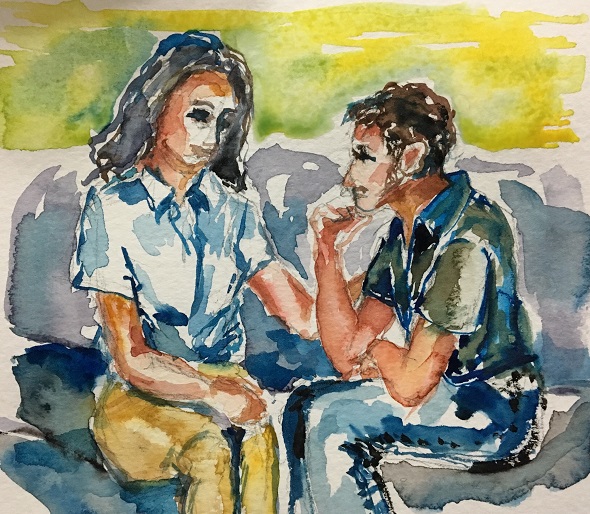
Watercolor by Jesi Pace-Berkeley

The views expressed are my own. This content is for informational purposes only and is not a substitute for medical or professional advice. Consult a qualified health care professional for personalized medical and professional advice.
How Does One Recover from Trauma Using CPT?

One purpose of research is to determine what helps most people, most of the time, better than other ways, and better than nothing.

One of the most effective therapies found by research to help people regain freedom from trauma symptoms is Cognitive Processing Therapy (CPT). CPT offers a sequence of 12 sessions, the first 6 of which are considered fundamental. If trauma symptoms abate, use of the protocol can be ended at any point in the sequence.

Inner wisdom

Addressing trauma can feel like too much. At the same, time, the sequencing of the CPT sessions can feel like too little, too slowly, especially if sessions are scheduled once per week. The founders of CPT suggest twice per week sessions as optimal and posit that all 12 sessions might be held in an intensive session, perhaps two days over a weekend. The intensively scheduled sessions might feel like too much, and they would also be enough, and all at once.

Some of the indirect learning and support that in-person CPT counseling sessions offer is missing from telehealth sessions, especially during the stress of a pandemic. With clients’ input, we have discovered that a) assistance with emotion regulation, b) a sense of progress outside of assessment scores, and c) an overview of the process, all in straightforward language, are needed.

Since I define terms and provide links to the content in this post elsewhere, I have provided few links here but have included a list of related resources at the end of the post.

“Inner wisdom” is our in-house term and adaption of “Wise Mind,” a component of the “States of Mind” concept from Dialectical Behavior Therapy (DBT) invented by Marsha Linnehan, Ph.D. In sum, the guidance of one’s “inner wisdom” would result from awareness of one’s thoughts and feelings – the content of one’s mind and heart – and from accessing emotion and cognitive structures and functions in the brain.

The content below is expressed in first person. The second person “you” can be perceived as directive and unhelpful.

What do I get from therapy for trauma?

I gain freedom and power.

If something troubling happens today, I am able to kindly – and without judgment – help myself with it.

When a troubling feeling or thought occurs, I can say, “Well, of course you would be feeling that feeling or thinking that thought, given what happened.” In doing so, I perform a profound act of compassion for myself.

What is the process by which one engages in therapy for trauma?

At essence, my intention is to be able to help myself with whatever is happening, whether it be an interior state or an external circumstance.

What is meant by “help myself”?

Help would begin with, kindly and respectfully, becoming aware of my feelings and thoughts and, thus, become able to access my inner wisdom wherein my knowledge, life experience, and skills reside.

Then I would use any or all of these meticulously acquired skills, in potentially most useful order:

  1. Adjust the volume on my inner intensity through self-soothing and attention-shifting so I can regulate the emotion centers of my brain and thus free my prefrontal cortex to think things through.
  2. When I become aware I am replaying the trauma in my mind or dwelling on intrusive thoughts, I very gently shift my attention, often to something that engages my senses and/or accesses my inner knowing. I’m aware that rethinking is like using flashcards to train myself to memorize what alarms and distresses me.
  3. If I am thinking some form of, “Who am I, who I am not, and what did I do or not do to cause this?”, remind myself that reality is complex and dynamic and very little can be definitively identified as causal.
  4. Remind myself that the “just-world hypothesis,”* however unsupportable, is based on my very human longing for things to make sense.
  5. Remind myself that it’s usually my humanity that wishes things were different AND that to increase my chances of effectively helping myself with a current reality, I’ll need to use a reality-based approach.
  6. Ask myself, “Do I have any self-care deficits going on? What can I do to buttress my ability to engage in the awareness process? Do I need food, water, to move a bit? What can I do to help myself feel more steady and strong?”
  7. Identify feelings and differentiate between natural, primary feelings, and thought-generated, secondary feelings.
  8. Ask, “What thoughts am I thinking that might be causing my feelings?”
  9. Among my thoughts, identify and differentiate between facts, beliefs, and hypotheses. (“Hypotheses” are posited to be reality-based vs. belief-based statements generated by one’s inner wisdom that may be truthful, if not verifiably factual.)
  10. Identify problematic patterns of thinking, particularly the “just-world hypothesis.”*
  11. Ask useful questions about my thinking (from an individualized set of questions derived from CPT’s Challenging Questions Worksheet).
  12. Among these questions, ask, “Is there any feeling here that I’m trying not to feel? What is it? Is there any reality here that I’m trying to not think about? What is it? Am I doing something to try to not feel or think? What realities do I need to approach rather than try to protect myself from?”
  13. Accept that humans are not given predictive powers. One’s own actions might have made things better…and they might have made things worse. There is no way to know.
  14. Ask, “Am I thinking in ‘if-thens’? Am I thinking, ‘If only I __________ or if only they __________’?” If so, I recognize I’m thinking I can know the complexity of reality and predict which factors would change which outcomes. I realize I’m just trying to think my way out of feeling sad. I give myself a hug for wishing things could be different.
  15. Then I do activate my prefrontal cortex. It helps me regulate emotions now. I’m also working it like a muscle to increase its power to help me in the future.
  16. Assess probabilities. Start by asking, “What are the odds? 50-50?”
  17. Ask, “What opposites are both true?”
  18. Do a cost-benefit analysis with rank ordering.
  19. Acknowledge family-of-origin issues (FOOI) that may be playing a role in my thinking process, give them a nod but little time, and shift my attention to my hard-won, individually identified values and priorities.
  20. Ask myself, “Let’s say I’m given 100 years on this planet. How would I want to spend them? How about the next 100 minutes? Is this to what I want to give my time? Might I have given this due time?”
  21. Ask myself, “Given these cards I’ve been dealt, how do I want to play them?”
  22. Devise strategies based on my values, priorities, and skills-informed, inner wisdom’s guidance.
  23. Ask, “I’ve consulted my inner wisdom. Is there anyone I might consult who is likely to honor the nuances of withholding judgment, fostering my independence, all the while offering commentary?!”
  24. Make a judgment call and execute the strategies.
  25. Accept outcomes as the best I could do at the time given the data and resources I had.
  26. Return to the opposites-are-both true dialectic of consolidating gains to foster stability AND opening myself to possible instability as I gain new insights and grow.
  27. Continue to monitor beliefs that oppress from without and from within. Become aware of familial, cultural, and societal beliefs that may be so deeply held that they are nearly invisible. Differentiate between those in which I willingly participate to organize society and those that limit me. Jettison the unhelpful beliefs that I can and shift my attention to my values, priorities, and inner knowing.

*”The just-world belief holds that good things happen to good people, that bad things happen to bad people, and that the world should be a fair and just place. This belief emanates from the desire to find an orderly, cause-effect association between an individual’s behavior and the consequences of that behavior…this is a hard-wired, evolutionary need of humans to predict and control events in order to survive.” (CPT manual, page 65)  Further, the just-world hypothesis holds that hard work will be rewarded, bad deeds will be punished, “things happen for a reason,” “what goes around comes around,” and that self, others, and the world should be controllable, orderly, and predictable. In contrast, reality is complex and dynamic. Some occurrences are unforeseeable and have no discernible origin, causality, meaning, or explanation. Ultimately, it is compassion for humans and their aching hearts that is merited.

Last updated 5/21/21

The views expressed are my own. This content is for informational purposes only and is not a substitute for medical or professional advice. Consult a qualified health care professional for personalized medical and professional advice.

Learning Mandarin Chinese Efficiently with Mandarin Blueprint

Life can be shorter than any of us may wish. I want to learn Mandarin Chinese in the most accelerated, efficient way possible.  I wish to reach as high of a level of proficiency in Mandarin Chinese as possible, as quickly as possible, with the least amount of effort, time, and dollars.

Further, that method has to work in lockdown in a small town. No opportunities for interactive practice or real life exposure exist outside of scheduled, online tutoring sessions with italki and private instructors.  Sequestered in my house, the rest is silence.

Luke Neale and Phil Crimmins, founders of Mandarin Blueprint

I have spent countless hours and dollars reviewing textbooks, courses, and apps, trying to find a means of learning Mandarin Chinese that meets these criteria.

I learned of Mandarin Blueprint on episode #55 of Jared Turner’s and John Pasden’s podcast, You Can Learn Chinese. I signed up for the free trial on Saturday, February 13, 2021, and was wowed.

To adults wishing to learn Mandarin Chinese efficiently, I recommend Blueprint wholeheartedly.

I had done literature reviews of the research on second language acquisition by adults. Of all the courses and materials I’ve reviewed, Mandarin Blueprint’s systematic approach most closely matches my findings.

In addition to offering a research-informed protocol, Mandarin Blueprint’s online course includes:

100% responsiveness to my schedule. I treasure speaking with online teachers so much that I have changed my sleep-wake schedule to more closely match Beijing time so I can meet with native speakers. However, I want and need to study when teachers are not available as well.

Accuracy. I have tried multiple online courses and apps. Even as a beginner, I could find errors in the content. I was learning the wrong stuff! Luke Neale and Phil Crimmins, the co-founders of Mandarin Blueprint, create impeccably accurate content.

Brief, succinct videos. I was a history major and am fascinated by China’s 5,000 year history. (Was there a Xia Dynasty?!) I appreciate context. At this point, however, please just tell me what I need to know.

Comprehensiveness. My scattered knowledge of bits of vocabulary and grammar is being consolidated. Systematically, Mandarin Blueprint takes students sound by sound, then character by character.

Fascinating content, often charmingly conveyed, by congenial, master teachers with strong speaking styles. I find myself engaged in the content and do not have to force myself to focus or continue. During this pandemic, on any given day, I frequently spend more time with Luke and Phil than I do with any other human beings. They are excellent company.

Use of strengths and interests I already have. Luke and Phil have devised an awe-inspiring process by which learners use memories from the richness of their personal lives, plus their imaginations, to create meaningful, memorable narratives associated with the pronunciation, components and meanings of Chinese characters, While my mind understands the power of the forgetting curve and the countering powers of the method of loci and spaced repetition, while learning with Mandarin Blueprint, I find my heart feeling at play as if I were a child again.

Uncertainties addressed by either the help desk or the Mandarin Blueprint community.  Anki is spaced repetition software (SRS) that buttresses learning with the Mandarin Blueprint method. I was able to set it up and use it for the Pronunciation Mastery course, but was stumped when I moved to the next level. Immediately, I got message board, email, and video responses to my questions. In one video, Phil has a cat in his lap! Phil even offered to Zoom and personally walk me through this step. I may have maxed out what I can do with Anki on my end, but “customer service” seems a mundane term for the direct, personal, serious help I received.

An innovation and a masterwork. I respect the co-founders for applying for a patent. I do think their formulation is a unique synthesis of research and best practices on second language acquisition. For me, engaging with such fine, thoughtful, original, humane work is a genuine emotional and intellectual pleasure.

Heroism. Luke Neale and Phil Crimmins launched Mandarin Blueprint in Chengdu, China on January 1, 2019. Native English-speakers, they were learning Mandarin Chinese as adults, joined forces, and devised the Mandarin Blueprint method to teach themselves efficiently and effectively. They then started sharing the method with others.

As of this writing, in about 28 months, they have created over 4,000 lessons and over 1,000 videos, ranging from 1 minute to 1 hour. They continue to create lessons, videos, blog posts, and podcast episodes. Through the videos, I have watched their lives unfold. I have seen Phil’s facial hair come and go and heard a baby chortle in one of Luke’s recordings. I can only imagine being non-native speakers founding a company in a non-native land, attempting to keep that company and their lives and loves afloat during a pandemic. and continuing to uphold the mission, create the course, and take care of their customers. I find their efforts quite moving and exemplary.

Outcomes. I need what I do to work. My life span is probably two-thirds complete. The pandemic has created new deprivations and urgencies. I need for the time, dollars and effort I put into anything to yield results. Before I tried this method, I struggled to read characters. With the support of my italki and private instructors, I have been able to read sentences aloud in the characters-only Mandarin Companion Breakthrough Level graded readers. Although a subjective measure, this is extraordinary, motivating progress.

Bravo to Luke and Phil! 谢谢! I truly cannot thank the founders of Mandarin Blueprint enough for their vision, leadership, and invention.

. . . . .

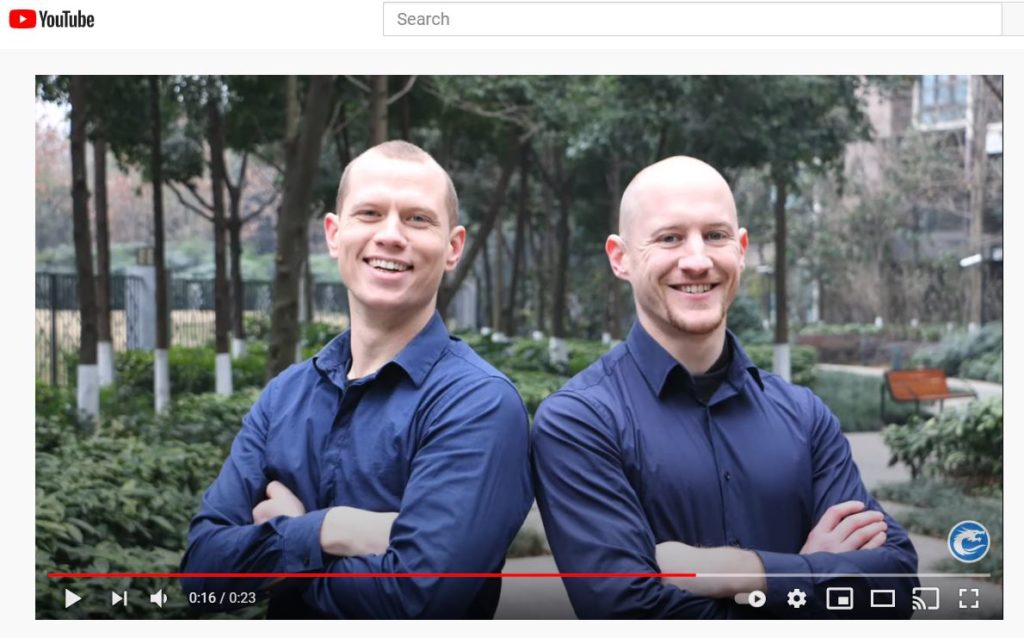
The image is a screenshot of Luke Neale and Phil Crimmins from a Mandarin Blueprint YouTube video explaining the Pronunciation Mastery course.

As of this writing, I completed the 6-hour Pronunciation Mastery Course during the trial period, purchased the full bundle of courses, and have completed through level 15, part of the Phase 3 Sentence Building portion of 36 levels in the Introductory Course. My plan is to complete the Introductory Course, then proceed to the Intermediate Course to complete levels 37-57. I feel confident I can do this, partly due to the inspiration of William Beeman, Professor Emeritus and past Chair of the Department of Anthropology at University of Minnesota, who also recommends Mandarin Blueprint.

An Advanced Course is in the works and I plan to take it as well when it is released. When test centers open again, I intend to proceed through the HSK exams.

For this post, I excerpted some of the content from the review I posted on my public Facebook page on March 9, 2021.

Updates as of 7/16/21

  • I was delighted to contribute at the access level to Mandarin Blueprint’s crowdfunding campaign to jumpstart development of the Advanced Course.
  • I and others are writing brief dialogues in simplified Chinese characters, pinyin, and English using words that help foster empathy and understanding. The posts also identify characters in Mandarin Blueprint’s numbering system. We call it the “Meaningful Words” series and it is here.
  • I developed a paper-and-pen alternative to Anki and describe it here.

Disclaimers

The views expressed are my own and may not represent Mandarin Blueprint’s positions, strategies or opinions. I receive no compensation from any businesses or organizations mentioned in this post.

I am a student of Mandarin Chinese and also a mental health counselor, able to provide counseling services only to residents of the Commonwealth of Virginia, U.S.A. This content is for informational purposes only and is not a substitute for medical or professional advice. Consult a qualified health care professional for personalized medical and professional advice.