About Grief

What’s to be done about grief?

Untitled by Trish Shelor White

It’s real.

It’s painful. The end in mind would be to feel less pain. Turning away is instinct. Forcing it to change is instinct. However, grief handled really, as it is, eases. What optimizes the easing of grief?

This is what I’ve become aware of about grief, from personal experience and training:

  • Neither stalling nor hustling help. Neither distracting nor avoiding help. Tough love hurts.
  • Turning towards the reality of grief, as it is, begins with self-kindness and compassion.
  • Grief without judgment, without beliefs, and without rules eases. “I should be feeling/thinking/doing ____,” and “I shouldn’t be feeling/thinking/doing _____,” exacerbate grief.
  • Seeing grief as it is offers up this question: “Can I help myself do something about this? Or is this something to help myself accept? Help do? Help accept?”
  • In the context of grief, acceptance can be having the bravery and compassion to rearrange one’s heart to make space for a new fact about being human, however unwelcome.
  • Replaying scenes to see if they truly happened the way they did or to see if different clues can be found to change the ending or its meaning works like flashcards to deepen painful memories, escalating grief. Becoming aware of replaying scenes is the time to say, “I have given that due time. I accept that it was the way it was.”
  • Being with people who aren’t grief-savvy exacerbates grief. The unconscious subtext under well-intentioned intoning of rules about grieving, e.g. “Time heals all wounds,” “You should travel,” or “_____ helps,” is usually judgment and criticism: “You should be over this by now. Why aren’t you farther along in ‘the grief process’? Follow my rules and you’ll get through it faster.” The deeper subtext can be that the person feels frightened and lonely without the person in grief.
  • Grief has to be felt and life has to be lived. Both are true at the same time. Opting out of either exacerbates grief. Grief is felt and relationships are tended. Both are true.
  • Guilt, a feeling born from the thought, “I should be/have been/do/have done more or something else,” often accompanies grief. Standard feeling and thinking skills can help:

“What am I feeling? Which of my feelings are natural human emotions and which are caused by thoughts? Which of my thoughts are facts and which are beliefs? Okay, let me challenge the beliefs and ease those thought-created feelings. And now let me help myself with whatever feelings are left and follow the facts!”

The vast complexity of each person’s brain and body, each person’s history, each person’s temperament, all suggest each person’s experience of grief, moment-to-moment, is individual and may fluctuate. Awareness, though, can help people decide moment-to-moment what is real and what can help.

Image: Untitled by Trish Shelor White

The content of this post is informed by the work of David Kessler and therapies derived from cognitive theory.

This content is for informational purposes only and is not a substitute for medical or professional advice. Consult a qualified health care professional for personalized medical and professional advice.


If You Are Having Trouble Regulating Your Emotions, Try This

Become aware of having an intense inner state.

Activate self-kindness and self-efficacy. Think, “I am going to help myself with this.”

Adjust the intensity of one's inner state

Name the primary feeling(s). Activate executive functioning structures and functions in your brain.

Primary feelings are natural feelings that go along with being human and happen automatically without thought: mad, sad, glad, afraid, surprised, disgusted, alarmed (includes fight-flight-freeze response).

Name the secondary feeling(s).

Secondary feelings happen as a result of thoughts – often thoughts that are opinions, beliefs, or rules – that cause feelings of shame, guilt, humiliation, self-blame, mistaken other-blame, regret, rage, panic, dread, despair, nostalgia, jealousy, righteousness, vengeance, and “ideations,” i.e. intrusive thoughts or fantasies of harm to self or others.

Ask yourself, “What thoughts caused these secondary feelings?”

Ask yourself, “What happened that activated this feelings-thoughts pairing?”

Ask yourself, “What are the facts about this trifecta of events, feelings, and thoughts?”

Think, “Given this data, what are my options to supportively and realistically help myself with this?”

Options come from:

The content of this post is intended to serve as text to copy and paste into a document to tape to the refrigerator or into the notes feature on a phone for easy reference. Plain language is used with a minimum of clinical terms. Clinical terms are linked to further explanations.

Image: iStock

The content of this post is informed by Cognitive Behavior Therapy (CBT), Dialectical Behavior Therapy (DBT), Cognitive Processing Therapy (CPT), Acceptance and Commitment Therapy (ACT), Positive Psychology, and other work. it was synthesized and compiled by Anne Giles, M.A., M.S., L.P.C.

This content is for informational purposes only and is not a substitute for medical or professional advice. Consult a qualified health care professional for personalized medical and professional advice.

Doing the Numbers on the Human Condition

Conceptually, to do easy calculations, let’s give each person 100 years on the planet. Although this is pure speculation, I estimate in their lifetimes humans handle 1,000 random, varied, meaningless hardships and make 1,000 mistakes.

Doing the numbers on the human conditionLet’s also assume that each person has some level of consciousness, defined for our purposes as awareness of the existence of the self and of other selves. Let’s also assume that reality is complex and dynamic. Let’s acknowledge that, currently, beyond the realm of calculating and estimating probabilities, the human brain does not have the power to change the past or know the future.
Now, to quote Kai Rysdal, let’s do the numbers.

“Despite the tendency to celebrate individual genius, humans’ true intellectual might is collective.”
– Morning briefing, The Economist, 10/23/21, reporting on When and Why Did Human Brains Decrease in Size? A New Change-Point Analysis and Insights From Brain Evolution in Ants, Frontiers in Ecology and Evolution, 10/22/21

What conclusions do I draw from seeing these numbers?

1) Even though I am 1 of 8 billion on the planet, and 1 of 100 billion who have ever lived, my consciousness is acutely aware that I have one, precious life.

2) Knowing the vastness of the human experience doesn’t minimize my experience. What happens to me happens to my universe.

3) My genetic makeup might just as easily have been dropped by the stork into another family’s chimney, at another place, in another time. This might mean:

  • Familial and geographic assignment are random.
  • Loyalty to family or to a nation is a choice, not an objective imperative.
  • Familial and cultural beliefs I have been taught might not be objective truth. (Gasp!)
  • What happened to me in my family of origin might not have happened to me if I have had been randomly assigned to another family.

A common, usually well-intentioned statement made to people who have experienced loss or hardship is, “It could have been worse.” Given the vastness of the human experience, it also could have been better.

Image: iStock

Updated 10/23/21

This content is for informational purposes only and is not a substitute for medical or professional advice. Consult a qualified health care professional for personalized medical and professional advice.

Feeling Anxious? Try This Pandemic Version of CBT

The pandemic has created a new environment for anxiety: some of our formerly fantastical worries are now grounded in reality. Although cognitive-based therapies term unrealistic fears “cognitive distortions” and “patterns of problematic thinking,” some of what we feared might occur is actually happening in our homes, towns, and countries.

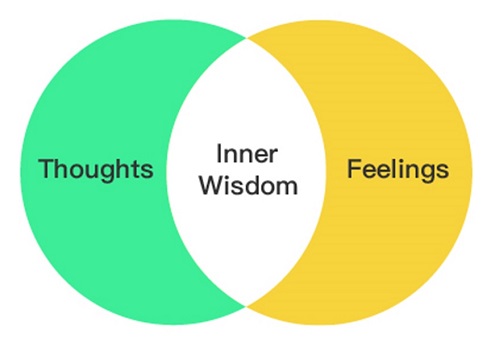
The human brain has evolved to handle hardship, however. In the brain, emotion-related regions and executive functioning regions work in synergy together, using feelings and thoughts as data to ease distress and solve problems. The term “inner wisdom” can be used to describe this brain function.

A helpful way to envision inner wisdom comes from an adaption of the concept of “Wise Mind” from dialectical behavior therapy (DBT). If feelings and thoughts are imagined as circles in a Venn diagram, the overlap between them offers the powerful synergy of each and both.

Inner wisdom

The challenge with fear, anxiety, and worry is that they highly activate the emotion-related regions of the brain, overwhelming the executive functioning regions and making inner wisdom difficult to access.

If I keep repeating worried thoughts to myself, I keep activating the emotion centers of my brain. The circle representing my feelings covers the circle representing my thoughts, limiting my access to the thinking regions of my brain, including the prefrontal cortex, and to the inner wisdom inherent in awareness of both feelings and thoughts.

Self-judgment and self-criticism – “I shouldn’t be feeling or thinking this way” – further exacerbate the dominance of my brain’s emotion centers.

Feeling anxious about feeling anxious – “Oh, no! Here comes anxiety again!” – does the same.

Trying to avoid what I’m feeling or thinking – or trying to distract myself from them – interfere with my brain’s ability to handle what’s happening. Avoidance and distraction divert me from my brain’s ability to help myself see what’s what and to do what needs to be done.

How can I stay present for both my feelings and thoughts and help my brain use its natural system to help me out during these hard times?

See if this inner narrative and these questions might help.

. . . . .

I have become aware I am having a thought about which I feel anxious.

  1. How realistic is this thought? What are the facts? (Many thoughts have some basis in reality. I can ask myself: On a scale of 1 to 10, where 10 is “It’s a fact verified by rigorous science,” and 1 is “I’m truly guessing,” how reality-based/fact-based is the thought?)
  2. How effective is this thought? Is it producing the results I want?
  3. How likely is the content of the thought to happen? On a probability line, where would I place the chances? 100% certain, a 50%-50% chance, impossible?
  4. Is my beautiful brain engaged in negativity bias, thinking it needs to more heavily weigh everything that might be a problem in order to keep me alive?
  5. Am I focusing on thoughts about one part of a situation and not taking into account other parts of the situation? Am I weighing one part of the situation more heavily than other parts? Is this merited?
  6. Have I thought this thought before? Have I given it due time?
  7. If noodling over this thought would have “fixed” it, might I have noodled enough to fix it by now? Might I try another approach?
  8. How helpful is the thought? Is it helping me feel better or worse? Is it helping me do better or do worse?
  9. Is the thought helping me feel more hopeful or more despairing?
  10. Is this thought scaring me or reassuring me?
  11. Is the thought related to judgment – which distresses me further – or acceptance, which helps ease my distress?
  12. What are the top 3 facts/realities I need to accept about what happened/what’s happening?
  13. Right here, right now, am I okay enough, at least for now?
  14. Regardless of any of my answers, how can I help myself with this?

I can feel what I feel, think what I think, and also shift my attention to thoughts that help me feel better, do better, and produce the results I would like.

. . . . .

Even attempting to formulate the words in these questions activates the thinking portions of the brain. As one client puts it – for which I’ve been given permission to share – we can purposefully “Get cognitive!” Although stated perhaps simplistically, the “thinking circle” in the brain shifts the “feelings circle” back to its place of providing helpful data and synergy for problem-solving.

The questions can help people become aware of the relationship between events, feelings, and thoughts. This cornerstone of cognitive-based therapies is often explained using an “ABC Worksheet”:

  • A – activating events result in
  • B – beliefs/thoughts and
  • C – consequences/feelings.

Here’s a .pdf entitled “ABC Worksheet – Pandemic Version” of the classic ABC worksheet with questions related to helping us through very challenging circumstances.

If you need help using these questions or want to further explore the ABC Worksheet or cognitive therapies, you’re encouraged to seek professional support.

Using our hearts and minds, plus the power of our beautiful brains, we can help ourselves through hardships – even through pandemics.

The content of this post is informed by Cognitive Behavior Therapy (CBT), Dialectical Behavior Therapy (DBT), Cognitive Processing Therapy (CPT), Acceptance and Commitment Therapy (ACT), Positive Psychology, and other work. it was synthesized and compiled by Anne Giles, M.A., M.S., L.P.C.

This content is for informational purposes only and is not a substitute for medical or professional advice. Consult a qualified health care professional for personalized medical and professional advice.

How to Learn Mandarin Chinese Efficiently and Enjoyably as an Adult

In early 2020, at age 61, the longing to return to the study of Mandarin Chinese after a 40-year hiatus came upon me. I met once with a private instructor in early March, 2020. Then the pandemic happened. I read the suggestion of Andrea Sachs of The Washington Post to learn a foreign language online during lockdown. I consider July 7, 2020 – my first meeting with an online italki instructor with whom I continue to work – as the official start of my return to serious study.

Nearly one year later, at the end of June, 2021, to bookend my efforts, I flew to Chicago to take Mandarin Chinese proficiency exams at the first and second levels. I am scheduled to receive my scores later this month.

Anne in Chicago's Chinatown

My first year of studying Mandarin Chinese was a bittersweet one.

With two-thirds of my expected life span over, I seek efficiency and optimization in many areas of my life. With regard to Mandarin Chinese, I want to learn to speak, understand, read, and write as proficiently as possible, as quickly as possible, with the least amount of time and effort, in ways that feel engaging and meaningful to me. According to the BBC, an educated Chinese person knows 8,000 characters. That sounds reasonable to me.

To evaluate my progress, to add credentials to my curriculum vitae, and to possibly open new professional opportunities, I decided to focus on studying for the Mandarin Chinese proficiency exams administered by the Chinese government, the globally recognized Hànyǔ Shuǐpíng Kǎoshì (HSK) 汉语水平考试.

I ran into trouble from the start. The standard HSK exam prep course materials are printed in a font size too small for me to read. The most-recommended college textbook does have an online version with an adjustable font size. I found the content about students’ lives uncompelling, however, and couldn’t imagine using school-related vocabulary in my life as a counselor in Blacksburg, Virginia at age 61.

Seeking alternative study materials to these top choices resulted in hours and hours of searching and testing, hundreds of dollars in purchases, a surprising and painful discovery of orthodoxies in both the traditional and contemporary schools of thought on the teaching and learning of Mandarin Chinese, then hours and hours of reviewing the research literature on second language acquisition to try discover a research-informed path.

In sum, although I am not sure of the size of the market, i.e. English-speaking adults seeking to learn Mandarin Chinese, this product niche is unfilled (with one exception, which I describe below): outcome-proven, comprehensive, Mandarin Chinese teaching and learning materials with content of interest to adults.

In hopes of assisting other adults interested in learning Mandarin Chinese, I have written the post I wish I had found a year ago when, after finding only materials for children and students, I refined my search query to “learning Mandarin Chinese for adults.”

How to Learn Mandarin Chinese Efficiently and Enjoyably as an Adult

To increase the likelihood of efficiently and enjoyably gaining proficiency in Mandarin Chinese as an adult, a systems approach is suggested. (Here’s a Wikipedia entry on systems theory and here’s a broad application of systems theory by my father, Robert H. Giles, Jr.)

Components of an efficient, effective study plan

Create an individualized study plan for yourself that includes these interrelated, interactive components:

  • Unorthodox instructors who – either by training or intuition – understand shaping, comprehensible input, comprehensible output, the forgetting curve, and “quick wins,” and who conduct their classes primarily in Mandarin Chinese, not English.
    Notes:
    (1) I have had stellar instructors I assume can speak English but I’m not sure because I’ve only heard them teach using Mandarin Chinese.
    (2) To learn more about shaping and comprehensible input, please see the video embedded in this description of Stephen Krashen’s Theory of Second Language Acquisition.)
  • A research-informed, outcome-focused, core course.
  • Graded readings
  • Writing for real purposes
  • Grammar consultation with instructors and with AllSet Learning’s Chinese Grammar Wiki rather than direct grammar instruction.
  • People with whom to practice speaking without correction or instruction.

Product recommendations

Instructors. Outstanding, unorthodox instructors can be found among the 1,850 Mandarin Chinese instructors available on italki, through AllSet Learning, and through referrals to private instructors. Asking a version of this question – “How have you decided to teach what you teach and in the way that you teach it?” – may be helpful in identifying versatile, thoughtful instructors.

I currently work with 4 online instructors, 30 to 60 minutes per session, 1-2 lessons per day. Depeng, Benfang, and Amy are with italki and one offers private instruction.

Core course. I recommend Mandarin Blueprint. I have explained why in detail here. I have tried more than a dozen other courses and apps and no other approach comes close to meeting these criteria: 1) uses a systems approach, and is 2) research-informed, 3) outcome-focused, and 4) engaging enough to continue. In this interview, Mandarin Chinese learner Chad Erickson cites similar reasons for using Mandarin Blueprint. William Beeman, Professor Emeritus at the  University of Minnesota, also recommends Mandarin Blueprint.

With Mandarin Blueprint, a barrier to entry was a high level of software expertise needed to use Anki, a form of spaced repetition flashcard software. I devised a paper-and-pen workaround to Anki and describe it here.

A private instructor in China has developed an astounding set of interactive slides to prepare students for HSK exams. This instructor does not have an online presence, but feel free to contact me for more information.

Graded readings. Mandarin Companion‘s characters-only graded readers are superior in content and engagement but coaching may be needed to transition from reading Pinyin to reading characters.

For example, on my computer screen, I displayed content of the Kindle versions of Edmund Chia’s Guo Guo Is Missing, then The Sports Boys (stories about kids, but if that’s the content that breaks the code of the English-pinyin-characters Rosetta Stone, so be it), interspersed with Mandarin Companion’s readers about Zhou Haisheng and Xiao Ming, and worked with instructors on deciphering characters. I can now read Mandarin Companion’s Breakthrough Level graded readers primarily on my own. I am a denizen of a nation with a loneliness epidemic, however, and prefer to read with an instructor and chat in Mandarin Chinese about the content.

The Chairman’s Bao is an online source of brief graded readings that provides characters, Pinyin, and English.

Writing for real purposes. Here is the method for writing with purpose and meaning that I am using. Added 7/24/21: I and others are writing brief dialogues about universal human concepts in simplified Chinese characters, pinyin, and English in hopes of helping people who speak all these languages understand each other a bit better.

People. Finding fellow Mandarin Chinese learners and native speakers willing to speak with learners in one’s locale can be difficult. During lockdown and afterwards, I attempted to find and form online Mandarin Chinese conversation groups that allow members to work out how to put their interior experience into words, and those words into sentences – however laboriously and however riddled with errors – without the use of English, and without correction or instruction by other members.

Paradoxically, interruptions in the name of “doing it right” may actually interfere with the brain’s construction of an inner network of understanding, termed an interlanguage. Within a group of people, extemporaneously practicing creating comprehensible output and taking in comprehensible input in Mandarin Chinese remains a yet-unrealized dream of mine.

Mandarin Chinese courses can have dropout rates as high as 95%. I posit that orthodoxy – a rigid adherence to beliefs about the way things are to be done, rather than pausing to analyze what yields results and what doesn’t – not the language’s difficulty, is the primary culprit.

For adults who are interested in learning Mandarin Chinese, or for adults who have have begun to learn and, due to troubling experiences or lack of progress, are heading towards that 95% dropout rate, I hope my hypotheses, explanations, and recommendations are helpful.

With questions or feedback, please contact me.

. . . . .

If of interest, here is more background on my thinking.

Definitions

  • I define orthodoxy as a set of beliefs and rules about “the right way” to teach and learn Mandarin Chinese.
  • In this context, I define optimize as a research-informed method to gain the most proficiency in Mandarin Chinese in the least amount of time, with the least amount of effort, with the most pleasure, such that the learner can understand and be understood by native speakers. Other methods may exist and produce results, but these methods would do so with less efficiency than an optimal method.
  • I define a systems approach as a way to simultaneously and synergistically attend to all components of teaching and learning Mandarin Chinese. Again, here’s a Wikipedia entry on systems theory and here’s a broad application of systems theory by my father, Robert H. Giles, Jr.
  • Although my untested hypotheses may have broader application, my focus is on English-speaking adults acquiring Mandarin Chinese as another language.

Origin of hypothesis about a systems approach

I hypothesize that a broadly encompassing systems approach can optimize the teaching and learning of Mandarin Chinese.

That hypothesis is based on:

  1. my reviews of the research literature on the neuroscience of second language acquisition, learning, and memory, particularly of Mandarin Chinese, particularly in older adults, and the psychology of learning,
  2. my knowledge, experience, and training as an educator and counselor,
  3. my virtual attendance of the National Chinese Language Conference in April, 2021,
  4. my year of attempting to learn Mandarin Chinese primarily in isolation, paradoxically ideal for collecting case study data since diverse variables were artificially controlled by lockdown, i.e. indirect learning opportunities through natural interaction or immersion in a language-speaking environment were non-existent, and
  5. my nascent attempts to teach English to native speakers of Mandarin Chinese,
  6. my having been schooled for at least 50 years by a systems thinker.

Specifically, as I explain more fully here, learners could optimize their acquisition of Mandarin Chinese – rather than through rote learning, sequenced learning, or using a task-focused approach – by engaging in a “flow” in, around, and through the five major language learning components of Mandarin Chinese – pronunciation/tones, Pinyin, vocabulary, grammar, and characters – while listening, speaking, reading and writing.

Disclosures: I am a current customer of italki, Mandarin Blueprint, and Mandarin Companion. I have been a customer of AllSet Learning. I receive no referral fees from any company or organization mentioned or linked to in this post.

Views expressed are my own.

I am a student of Mandarin Chinese and also a mental health counselor, able to provide counseling services only to residents of the Commonwealth of Virginia, U.S.A. This content is for informational purposes only and is not a substitute for medical or professional advice. Consult a qualified health care professional for personalized medical and professional advice.