A workshop by Anne Giles, M.A., M.S., L.P.C.. for the Western Virginia Public Education Consortium‘s event, An Educator’s Guide To Mental Well-Being, on Thursday, 2/29/2024 at Radford University, Heth Hall 043, 1:00 PM, Radford, Virginia.
Nota bene: Research-informed, plain language summaries are used below. To examine the research on these subjects, please use PubMed.
Outline, notes, and links
I respect our coordinator’s brave and bold question to me: “How do you maintain a sense of well-being after trauma?”
Let’s begin by defining terms.
Definitions
The definition of mental health continues to evolve. This definition from Wren-Lewis and Alexandrova (2021) speaks to me: “…the capacities of each and all of us to feel, think, and act in ways that enable us to value and engage in life.”
I’ll define well-being as a sense of contented mental health.
Having a sense of contentment in 2024 is a big ask. Especially after trauma. Even beyond imagining.
Let’s see how it might be possible.
For our purposes, I’ll define trauma as experiencing, witnessing, or learning of an occurrence, from which one was unable to protect oneself, that alarms, shocks, and/or causes such emotional, psychological, existential, and/or physical pain that it overwhelms the brain and changes the person’s way of seeing themselves, others, and the way the world works. After trauma, feelings of powerlessness and helplessness may persist.
The human brain, however, has evolved to handle hardship. Specifically, the human brain has evolved these strengths: a) to recover stability (also termed resilience, and b) to be altruistic. Counting on, and playing to, the strengths of the human brain can foster recovery from trauma.
What maintains a sense of mental health and well-being and what does trauma do to it?
Part 1. Fundamentals of maintaining a sense of mental health and well-being
Fundamentals of maintaining enough of a sense of mental health and well-being, enough of the time, to function, value, and engage:
- Self-kindness / Self-altruism. Humans are innately humane, altruistic, and beneficent to themselves and others.
- Self-care: Self-Care Checklist
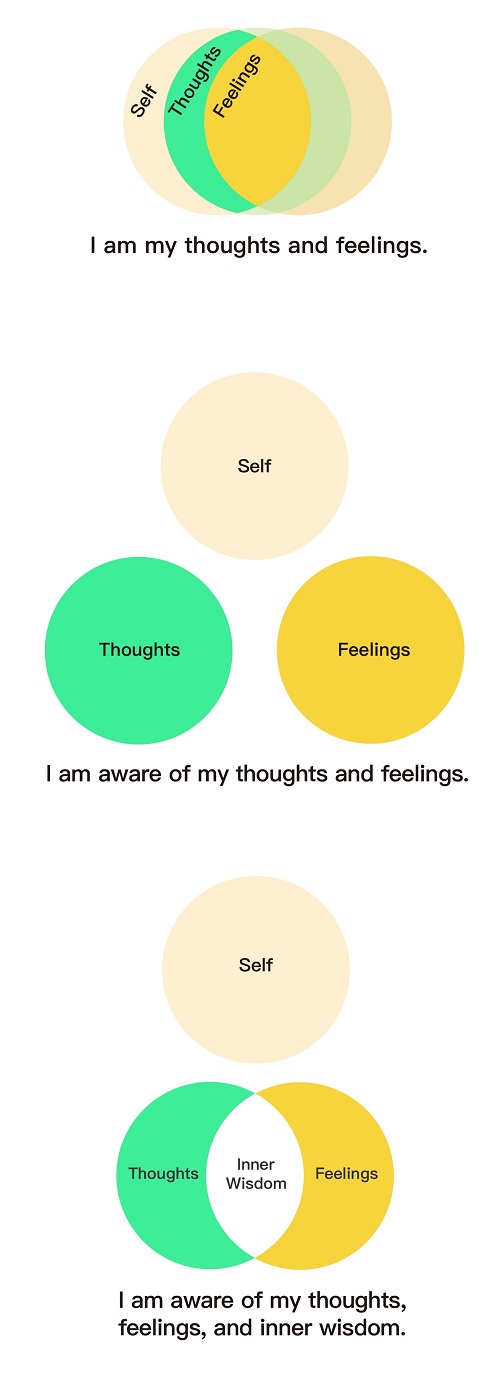
- Awareness – of one’s interiority, of one’s words and actions, of one’s situation, and of the context of reality as it is
- Emotion regulation
Part 2. Impact of trauma on a sense of well-being.
What does trauma do to a sense of well-being? Many, many things.
A. Attention. The impacts of trauma can occur to one’s attention.
- Attention to reality as it is
However much we may wish otherwise, what happened cannot be un-happened.
With self-kindness and self-compassion, with kindness and compassion towards everyone everywhere, what happened to us is part of of the story of the 100 billion people estimated to have ever lived. part of the 300,000 year history of Homo sapiens.
Seeing reality as it is can produce intense feelings. This is why emotion regulation skills are crucial. The brain needs its full functioning to help us navigate challenges.
- Attention to thoughts
If you imagine the content of your thoughts as a pie chart or circle graph, what percentage of your thoughts are about the past, the present, the immediate future, or the longer-term future?
What percentages do you think would enhance your sense of well-being?
- Attention to self, others, and the world
B. Self-efficacy. The impacts of trauma can occur to one’s sense of self-efficacy.
Self-efficacy is the belief in one’s capability to produce desired outcomes within one’s realm of influence, i.e. to use the three-lane highway metaphor, in one’s own lane.
If you imagine self-efficacy as a quantity within a container, trauma can deplete a person’s sense of self-efficacy. After trauma, a person may need to fill the container back up.
Part 3. Acknowledge. Adjust.
In sum, how might one begin to take small steps towards restoring or gaining a sense of well-being after trauma?
Acknowledge. Adjust.
With self-kindness, acknowledge reality as it is: the reality of one’s interiority, one’s words and actions, and one’s external situation. Use skills to adjust. Decide what’s next based on one’s strengths, values, and priorities.
Workshop handout and discussion questions
. . . . .
I hypothesize that the central human task is to gain the perspective, approach, and skills to be able to, within oneself – with self-kindness, without self-judgment, and without the external support of others or from one’s environment – feel all, think all, experience all, function, assess, pause or initiate, all at once, no matter how many burdens one has, how small or large they may be, or how fast new ones keep coming, no matter how vulnerable, uncertain, impaired, hurt, or threatened one is or feels, no matter who is present or missing, no matter what is happening, no matter what has happened, no matter what is to come.
In sum, the end in mind is to care for the self as fully as one can through handling reality realistically.
Last updated 3/18/2024
All content on this site is for informational purposes only and is not a substitute for health care, medical, or professional advice. Consult a qualified professional for personalized health care, medical or professional advice.